Predictable lead generation for sign companies requires a dual outbound and inbound pipeline focused on high-ticket commercial accounts rather than low-margin retail walk-ins.
Executing account-based outreach to commercial General Contractors and property developers, combined with municipal permit tracking and pre-qualified inbound search systems, allows custom sign fabricators to generate consistent $10,000 to $100,000+ contracts while protecting estimator bandwidth.

Most commercial sign fabricators operate on an unpredictable revenue cycle. One month is filled with lucrative monument sign installations and corporate re-branding rollouts, while the next relies on walk-in banner orders that barely cover shop overhead. Relying strictly on word-of-mouth recommendations or generic marketing channels creates sharp revenue swings and leaves high-margin commercial projects to aggressive regional competitors.
Building a predictable client pipeline requires a targeted B2B lead generation strategy. Commercial signage contracts for office parks, retail centers, and industrial facilities range from $10,000 to over $100,000. Winning these accounts demands systematic outreach to general contractors, commercial property managers, and real estate developers long before they submit public bid requests.
The Shift from Retail Walk-Ins to High-Ticket Commercial Accounts
Custom sign fabrication involves distinct business units with contrasting financial profiles. According to industry valuation benchmarks compiled by CT Acquisitions, commercial custom fabrication and installation operators generate significantly higher EBITDA multiples and recurring account value than walk-in retail print shops.
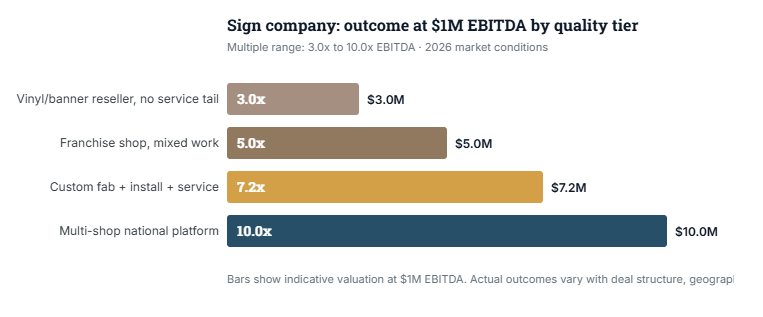
Retail buyers ordering short-term banners or vinyl window graphics require high customer service volume for low transaction sizes.
Commercial buyers operate differently. Property management firms affiliated with BOMA International, retail franchisors, and commercial general contractors require ongoing signage services, including site surveys, structural engineering drawings, municipal permitting, fabrication, and installation. A single relationship with a regional general contractor can yield dozens of commercial build-out projects annually.
Data from Business Research Insights indicates that digital and interactive displays now account for 54% of global signage demand, with traditional illuminated signs holding 46%.
Capitalizing on high-value installation trends like LED channel letters, pylon signs, and digital message centers requires lead generation systems tailored specifically to B2B decision-makers, supported by industry insights from the International Sign Association.
Comparing Commercial Signage Lead Generation Channels
Not all lead channels produce equal profit margins. Selecting the right acquisition method depends on shop capacity, sales team structure, and target project sizes.
| Lead Acquisition Channel | Primary Decision Maker | Typical Project Value | Average Sales Cycle | Pipeline Margin Potential |
|---|---|---|---|---|
| Municipal Permit Tracking | Commercial Developers, Tenant Reps | $15,000 to $75,000 | 60 to 120 Days | Very High |
| Property Manager ABM | Facilities Directors, Asset Managers | $20,000 to $100,000+ | 45 to 90 Days | High (Recurring LTV) |
| High-Intent Search (PPC/SEO) | Business Owners, Office Managers | $2,000 to $15,000 | 7 to 30 Days | Moderate |
| General Contractor Outreach | Project Executives, Estimators | $10,000 to $50,000 | 30 to 60 Days | High Volume |
1. Municipal Permit Mining: Capturing Build-Outs Early
The earliest indicator of a commercial signage project is an active municipal permit filing. Commercial developments tracked by real estate groups like NAIOP, interior retail build-outs, and structural building renovations require electrical, structural, or zoning permits months before physical construction begins.
Sign companies can build a proprietary lead pipeline by systematically scraping city building department databases and planning commission agendas. Identifying a commercial tenant or property owner during the permit review stage allows sales representatives to initiate contact before architectural plans finalize their signage schedules.
When reaching out to permit applicants, open the dialogue around municipal zoning limits, wind-load requirements, and local sign code compliance. Position your team as municipal permit experts who simplify sign approvals rather than just vendors selling channel letters.
2. Account-Based Marketing for General Contractors and Property Managers
One-off commercial jobs provide short-term revenue, but repeat corporate accounts drive long-term business enterprise value. General contractors overseeing commercial developments and property managers handling multi-tenant retail plazas constantly need reliable sign fabricators who handle installation without project delays.
To acquire these accounts, deploy targeted cold outreach campaigns focused on commercial decision-makers. Partnering with an expert B2B appointment setting agency helps sign shops systematically reach regional project executives via personalized cold email sequences and structured LinkedIn engagement.
Effective account-based campaigns highlight specific operational capabilities that solve general contractor pain points:
- Licensed Electrical & Structural Installation: Confirming active compliance with safety standards set by UL Solutions (UL 48 listing) and master electrician credentials upfront.
- Turnkey Permit Management: Demonstrating proven experience securing variance approvals with local zoning boards.
- Dedicated Estimating SLA: Guaranteeing 48-hour turnarounds on budget estimates to support general contractor bidding deadlines.
- Detailed Renderings & Material Specs: Providing complete vector shop drawings that match architect specifications.
3. Establishing a Strict Pre-Qualification Gate for Inbound Inquiries
A major bottleneck for custom sign fabricators is the wasted bandwidth spent estimating unqualified leads. Custom signage estimating requires structural calculations, material costing, labor allocation, and installation site review. Spending three to five hours creating detailed renderings for price shoppers who take drawings to budget cutters severely drains shop profits.
To protect estimator bandwidth, implement a mandatory 5-point lead qualification gate before any project moves to design or estimating:
- Artwork Vector Status: Confirm whether the client possesses scalable vector files (.EPS, .AI, .PDF) or requires custom graphic design services.
- Site Survey Readiness: Verify wall dimensions, mounting substrate type (EIFS, brick, tilt-up concrete), and installation height access.
- Electrical Access & Supply: Determine if primary power is present at the sign location or if new electrical service runs are required.
- Landlord & Municipal Approvals: Confirm written landlord authorization and check local sign criteria limitations for the property.
- Target Budget & Timeline: Verify that project budget expectations align with custom fabrication costs before committing engineering resources.
Research published by the Sign Research Foundation demonstrates the clear economic value of on-premise signage for commercial businesses. Presenting empirical ROI data during intake helps pre-qualify budget parameters early in sales discussions.
4. Aligning Inbound Search Strategy with Commercial Buyer Intent
While outbound prospecting secures large accounts, inbound search engine optimization (SEO) and targeted pay-per-click (PPC) campaigns capture immediate, high-intent buyers replacing damaged signs or undergoing sudden re-branding.
Avoid generic keywords like “sign shop” or “custom banners” which attract low-margin consumer queries. Structure paid search campaigns around high-intent commercial terms, including:
- Commercial LED channel letter fabricator
- Architectural pylon sign replacement
- Monument sign design and installation
- Multi-tenant retail sign criteria contractor
- UL listed illuminated sign manufacturer
Ensure landing pages emphasize proof of commercial execution, including project photo galleries, municipal permit credentials, client logos, and direct call-to-actions for commercial site surveys.
5. Integrating Lead Pipelines with Sign Shop MIS Platforms
Marketing campaigns fail when incoming leads get lost in email inboxes or unorganized spreadsheets. Lead management must connect seamlessly with custom shop management software to maintain rapid response times.
Modern sign shops utilize specialized management software like ShopVox or Cyrious to handle quoting, job costing, proofing, and production scheduling.
Connecting front-end marketing platforms or CRMs like HubSpot with shop management systems ensures that when an SDR converts a commercial lead, project details flow directly into estimator queues without manual data entry errors.
How Xynario Accelerates Lead Generation for Sign Companies

Scaling commercial signage sales requires consistent B2B prospecting, but sign shop owners and estimators rarely have time to make 50 cold calls a day or manage complex outbound campaigns. Xynario solves this bottleneck by building dedicated B2B appointment setting engines built specifically for custom sign fabricators and commercial installers.
Xynario handles the entire outbound sales pipeline, from identifying upcoming commercial build-outs to booking qualified meetings with key decision-makers. Here is how Xynario transforms sign shop lead generation:
- Targeted GC & Property Manager Prospecting: Xynario identifies and engages verified project executives, commercial general contractors, and asset managers who regularly award signage contracts.
- Permit-Triggered Cold Outreach: By monitoring commercial building permit filings and local real estate expansion notices, Xynario initiates dialogue with developers long before public bidding starts.
- Strict Pre-Qualification Protocols: Every lead is vetted for budget, project scope, vector artwork readiness, and timeline before landing on your calendar, ensuring zero wasted estimating hours.
- Turnkey SDR Infrastructure: Sign fabricators get access to trained B2B sales development reps, premium prospecting databases, and multi-channel email/LinkedIn automation without adding fixed payroll overhead.
Choosing Xynario allows your internal team to focus on site surveys, engineering drawings, and closing deals, while an automated outbound system consistently fills your shop with high-margin $10,000 to $100,000+ commercial projects.
When to Outsource Commercial Lead Generation

Deciding whether to build an in-house sales prospecting team or partner with an outbound growth agency comes down to overhead costs, setup time, and management bandwidth.
| Operational Factor | In-House Sales Development Representative | Specialized Outbound Agency Partner |
|---|---|---|
| Setup & Ramp Time | 3 to 6 months (Hiring & Training) | 2 to 4 weeks (Immediate Execution) |
| Annual Cost Burden | $75,000 to $110,000+ (Salary, Tools, Benefits) | Flexible Monthly Service Retainer |
| Data & Prospecting Tech Stack | Requires purchasing separate licenses | Included in agency infrastructure |
| Management Oversight | Requires daily sales management | Managed account lead and executive reporting |
Who This Outbound Strategy Is Not For
Systematic B2B lead generation requires dedicated sales response capacity and execution infrastructure. This strategy is not recommended for:
- Retail-Only Print Shops: Businesses solely producing small-format digital prints, stickers, or vinyl banners under $500.
- Shops Without Installation Capabilities: Fabricators lacking licensed installation crews, bucket trucks, or subcontractor networks for site work.
- Operators Lacking Estimating Bandwidth: Shops that cannot deliver formal commercial quotes within 48 to 72 hours of pre-qualification.