We curated a set of the 20 most critical lead generation questions, synthesized from multiple trusted independent buyer guides, RFP checklists, deliverability standards, and qualification frameworks published between 2023 and 2026.
Our goal is simple: give buyers a practical, evidence-based filter instead of another list of soft “best practices.” You can verify all the sources at the end of this article.
First Get Clear on What You Are Buying
Before you ask any agency a single question, lock down the language. Most arguments later start because both sides used the same words for different things.
- Contact: just a name, email, and title.
- Verified contact: the details have been checked for accuracy and deliverability.
- Lead: a contact that meets basic firmographic or role filters.
- Qualified lead: also meets budget, authority, need, and timeline criteria you both agreed on in writing.
- Meeting: a scheduled conversation the prospect accepted.
- Opportunity: a real deal created in the CRM after the meeting shows commercial interest.
A 2025 peer-reviewed study published in Frontiers in Artificial Intelligence looked at real B2B CRM data from 2020 to 2024. It confirmed that lead prioritization matters because sales teams have limited time and need to focus on leads with higher conversion potential. Lead source and lead status were useful predictors. Volume without prioritization simply wastes capacity. Frontiers study on lead prioritization
HubSpot’s 2026 marketing statistics also show that 40 percent of marketers now treat lead quality and MQLs as their most important success metric. Pure volume is no longer the main scoreboard for serious teams. HubSpot 2026 Marketing Statistics
Here are the 20 Most Critical Lead Generation Questions Before You Hire an Agency

Use these questions in discovery calls and written RFPs. Listen for specific, verifiable answers. Vague language is usually the first warning sign.
1. How do you define a qualified lead or qualified meeting for clients like us?
Why it matters: This is the single highest-leverage question. Everything else depends on the answer.
A good agency will answer with a written definition that covers firmographics, role and seniority, budget indicators, decision authority, and buying timeline. They will attach that exact definition to the statement of work so both sides can reference it later.
If they say “We deliver high-intent decision-makers” or “Our AI scores intent” with no measurable criteria you can audit, walk away. That is volume language, not qualification language.
2. Which ICP criteria are mandatory versus preferred?
Why it matters: Mandatory criteria protect your sales team’s time. Preferred criteria give the agency room to work without turning every lead into a negotiation.
A good agency will answer with a clear separation. For example, company size and industry are mandatory. Specific technology stack or exact title variations are preferred. They will put both lists in writing before launch.
If they say everything is “flexible” or “we adapt as we go,” you will spend the next three months arguing about every single lead. That is a red flag.
3. How do you verify buying intent before a lead reaches sales?
Why it matters: Not all intent signals are equal. A pricing-page visit is weaker than a reply that asks about implementation timelines or budget cycles.
A good agency will answer with a multi-signal process that combines engagement, firmographic fit, and explicit interest, plus a human review gate before the lead is pushed into the CRM.
If they say their scoring is fully automated with no human check, This increases the risk of low-intent meetings that waste sales time.
4. Where does your contact data come from?
Why it matters: Data source sets the ceiling on quality, deliverability, and compliance risk.
A good agency will answer by naming the providers or describing their proprietary research process, plus a clear verification process. They will also state freshness rules and ownership terms up front.
If they say “multiple databases” or “proprietary technology” and stop there, you have no visibility into quality or compliance risk. That is a soft red flag that usually becomes a hard problem later.
5. How often is data refreshed and what bounce rates do you typically see?
Why it matters: Stale data produces bounces that quietly damage domain reputation over time.
A good agency will answer with a documented refresh cadence and recent campaign bounce rates that consistently stay under 5 percent on verified lists. They will share actual numbers, not just claims.
If they have no bounce-rate target or refuse to share recent numbers, You should not proceed without clarifying the data is older and dirtier than they admit.
6. Who owns the contact data and campaign assets when the engagement ends?
Why it matters: Ownership decides whether you can continue the work in-house or switch vendors without starting from zero.
A good agency will answer that you own the data and sequences. Clean export in CSV or native CRM format is included at no extra cost.
If they keep exclusive ownership or charge large exit fees for the data, you are locked in. That is a structural red flag.
7. How do you select target accounts and contacts?
Why it matters: Account selection quality determines whether your sales team spends time on the right buying committees.
A good agency will answer with an ICP-driven list-building process that uses firmographic, technographic, and intent filters, and they will review the final list with you before launch.
If they say they already have a large database for your industry or rely on generic purchased lists, expect a high volume of wrong accounts.
8. Which channels will you use and who writes the messaging?
Why it matters: Channel mix and message ownership affect both results and brand risk.
A good agency will answer with a multi-channel plan matched to your sales cycle and clear client approval rights on messaging.
If they offer only one channel or fully automated messaging with no review step, you lose control of both brand and conversion quality.
9. Who handles replies and books the meetings?
Why it matters: Response quality and speed influence show rates and whether meetings turn into opportunities.
A good agency will answer with named team members or a clear process that includes response-time targets and a qualification gate before any meeting is booked.
If they say “Our system books automatically” with no human qualification step, expect a high no-show rate and low opportunity conversion. Treat this as a warning sign and ask for evidence.
10. Which metrics do you report and can I see CRM-level opportunity data?
Why it matters: Activity metrics hide quality problems. Pipeline metrics reveal them.
A good agency will answer that they track contact-to-meeting, meeting-to-opportunity, and opportunity value inside your CRM and give you full visibility.
If they focus heavily on emails sent, opens, or raw meetings booked without quality filters, they are optimizing for activity, not pipeline.
11. What happens when lead quality drops?
Why it matters: Every program has variance. How the agency responds to that variance tells you whether they are a partner or a vendor.
A good agency will answer with a written replacement or credit policy tied to the qualification definition, plus a defined optimization process.
If they say “We will look into it” or have no formal policy, you will be arguing about quality every month with no contractual leverage.
12. Can you show results from clients in our industry with similar deal sizes?
Why it matters: Vertical and deal-size relevance predicts whether results will transfer.
A good agency will answer with named references you can contact, plus sample campaign data under NDA if needed.
If they only show logo walls or case studies from unrelated industries, treat it as a soft red flag. This makes quality harder to evaluate.
13. How do you charge and what is included versus extra?
Why it matters: Hidden costs and misaligned incentives usually surface after the contract is signed.
A good agency will answer with a clear line-item breakdown of data, domains, tooling, reporting, and creative.
If they only offer bundle pricing with no visibility into the components, expect surprise invoices later.
14. What is the minimum commitment and what are the exit terms?
Why it matters: Exit rights protect you when quality or fit fails.
A good agency will answer with a 90-day pilot with clear go/no-go criteria, or month-to-month after an initial period. Data export is included.
If they require a 12-month lock-in with 60- or 90-day notice and no performance clause, all the risk sits on your side.
15. Can we run a paid pilot before full commitment?
Why it matters: Pilots surface real delivery quality under controlled conditions.
A good agency will answer yes, with predefined success metrics and a clear path to continue or stop.
If they demand a full annual commitment before any delivery happens, they are not confident enough in their own process to prove it first.
16. Who owns the sending domains and infrastructure?
Why it matters: Shared infrastructure creates cross-client reputation risk.
A good agency will answer that they use dedicated or carefully segmented domains with full authentication under your control or clear handover terms.
If they use shared domains or refuse to discuss infrastructure details, your domain reputation is at risk from other clients’ poor practices.
17. How do you handle SPF, DKIM, and DMARC?
Why it matters: Google’s sender requirements differ by sending volume. Bulk senders need email authentication, including SPF and DKIM, and must meet additional DMARC and alignment requirements. Unauthenticated messages face higher spam placement or rejection. Google Email sender guidelines
A good agency will answer that they run full authentication on all sending domains, monitor continuously, and give you visibility into the configuration.
If they say “Our ESP handles it” with no client-visible configuration, you have zero control when deliverability problems appear.
18. How are opt-outs and compliance handled?
Why it matters: The FTC requires accurate sender information, a valid postal address, and a working opt-out mechanism for commercial email. Both the brand and the sender can be held responsible. FTC CAN-SPAM compliance guide
A good agency will answer with a documented process, client visibility into suppressions, and clear ownership of compliance responsibility.
If they only claim “best practices” with no process detail, compliance risk sits with you by default.
19. What is your process for list hygiene and bounce handling?
Why it matters: Ongoing hygiene protects domain reputation over months, not just at launch.
A good agency will answer with regular verification, automatic suppression of hard bounces, and transparent reporting on list health.
If they have no documented hygiene process, expect rising bounce rates and gradual domain damage.
20. Who is responsible if our domain reputation is damaged?
Why it matters: Reputation damage can affect every future email from that domain.
A good agency will answer with clear contractual language on monitoring, remediation steps, and liability allocation.
If they refuse to discuss reputation risk or focus only on their own domains, the downside sits entirely with you.
Agency Evaluation Scorecard
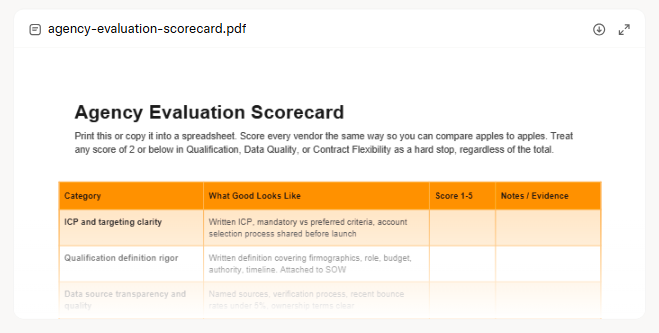
Print this or copy it into a spreadsheet. Score every vendor the same way so you can compare apples to apples. Treat any score of 2 or below in Qualification, Data Quality, or Contract Flexibility as a hard stop, regardless of the total.
Download the scorecard:
- Excel version (.xlsx) : ready for scoring and notes
- PDF version (.pdf) : print-ready
- If you prefer Full PDF Guide : scorecard + all 20 questions in one clean file
| Category | What Good Looks Like | Score 1-5 | Notes / Evidence |
|---|---|---|---|
| ICP and targeting clarity | Written ICP, mandatory vs preferred criteria, account selection process shared before launch | ||
| Qualification definition rigor | Written definition covering firmographics, role, budget, authority, timeline. Attached to SOW | ||
| Data source transparency and quality | Named sources, verification process, recent bounce rates under 5%, ownership terms clear | ||
| Channel strategy fit | Multi-channel plan matched to sales cycle, messaging approval rights for client | ||
| Messaging ownership and quality | Client can review and reject messaging. No fully automated black-box outreach | ||
| CRM and reporting depth | Opportunity-level data inside client CRM. Contact-to-meeting and meeting-to-opportunity rates visible | ||
| Pricing transparency | Line-item breakdown of data, domains, tooling, reporting, creative. No hidden add-ons | ||
| Contract flexibility and exit rights | 90-day pilot or month-to-month after review. Clear data export. Performance clause present | ||
| Proof and relevant references | Named clients in same or very similar vertical and deal size that you can actually contact | ||
| Compliance and infrastructure | Dedicated or segmented domains, full SPF/DKIM/DMARC, documented opt-out and hygiene process |
Pricing Model Comparison
None of these models is automatically better. Each one changes the agency’s incentives. Choose the model that matches how tightly you can define and enforce quality.
| Model | How It Works | Buyer Benefit | Buyer Risk | Best Fit When |
|---|---|---|---|---|
| Monthly retainer | Fixed monthly fee for a defined scope of work | Broader control over process, messaging, and optimization | You pay before results fully mature | You want strategic multi-channel work and close collaboration |
| Pay per lead | Fee only for leads that meet the written definition | Simple unit economics | Disputes over whether a lead truly met the criteria | You have a very tight, auditable acceptance standard |
| Pay per appointment | Fee only for booked and accepted meetings | Easy to understand and measure | Volume can quietly replace quality if show rates and conversion are ignored | You have strong qualification gates and track show-to-opportunity rates |
| Performance or revenue share | Fee tied to closed revenue or pipeline value | Strongest incentive alignment | Attribution becomes complex and arguments arise over credit | You already have mature closed-loop tracking and clean CRM data |
Agency vs In-House vs Hybrid
Not every company should hire an agency. Use this simple filter before you start vendor conversations.
- Choose an agency when you need multi-channel pipeline inside 30–60 days, lack internal SDR capacity, or need specialized technical work (authentication, deliverability, CRM orchestration).
- Build in-house when you already have a proven playbook, a stable ICP, and the management bandwidth to hire, train, and retain people.
- Consider hybrid or fractional when you want to validate messaging and ICP fit quickly while you build internal capacity. The agency handles initial volume and list work. Your team owns follow-up and closing.
For more detail on building internal capacity, see the guides on outbound SDR team design and sales staffing options.
Who This Framework Is Not For
These 20 critical questions and the scorecard are not useful if you only care about the lowest cost per contact, if you still do not have a defined Ideal Customer Profile, or if you are unwilling to enforce written qualification standards. In those cases the questions will create friction, might be possible you are not prepared to act on. The framework also assumes your team can follow up on meetings in a reasonable window. Slow internal follow-up will waste even high-quality leads.
How to Use This in Practice
Follow these steps in order. Do not skip the first three.
- Write your Ideal Customer Profile and the exact definition of a qualified lead / qualified meeting before you speak to any agency.
- Send the full list of 20 questions in writing (email or RFP) at least 48 hours before the discovery call.
- On the call, force every answer into the scorecard the same day. Score each category 1–5 while the conversation is still fresh.
- Treat any score of 2 or below in Qualification definition, Data quality, or Contract flexibility as an automatic disqualification, regardless of total score.
- Require the critical definitions (qualified lead, replacement policy, data ownership, exit terms) to appear in the statement of work before you sign anything.
- Run a paid 30–90 day pilot with clear success metrics. Only move to a longer commitment after the pilot data is reviewed inside your own CRM.
For a broader selection checklist that covers specialization, red flags, and pricing ranges, read the existing guide on how to choose a B2B lead generation agency.
For service details on verified pipeline, AI-assisted qualification, CRM execution, and email infrastructure, review the pages on B2B lead generation services, AI lead scoring, CRM and automation, and email marketing.
The agencies that answer these questions clearly and accept the corresponding contract language are the ones worth testing. The ones that cannot usually turn budget into contacts instead of pipeline.
Sources & Our Research Basis
We used public buyer guides as a starting point, then reorganized the questions around qualification definitions, data ownership, deliverability, contract risk, and CRM-level outcomes. The scorecard and decision rules are Xynario’s practical framework.
- SaaS Hero – 21 Questions to Ask a Lead Generation Agency (qualification definition, data sourcing, reporting)
- Phi Consulting – Seven Questions to Ask Every Lead Gen Agency
- DoneMaker – 10 Questions to Ask Before You Sign
- LaunchLeads – Buyer’s Guide from a $3B Pipeline Operator (contract clauses, pilot structure, data ownership)
- Leadbull – 10 Critical Questions for B2B Lead Generation Agencies
- Siete – Top 10 Questions Before Hiring a B2B Lead Generation Agency
- Google Email Sender Guidelines (SPF, DKIM, DMARC requirements for bulk senders)
- FTC CAN-SPAM Act Compliance Guide
- BANT qualification framework (originally developed at IBM) and MEDDIC (PTC) – standard industry references for budget, authority, need, timeline, and complex-deal qualification
- Bounce-rate benchmarks from Cleanlist, Belkins, and Validity (healthy verified lists typically under 2–5 %)
The questions were cross-checked against these sources for consistency on the highest-leverage topics: written qualification standards, data provenance, infrastructure ownership, contract exit rights, and CRM-level pipeline reporting.
Want the printable version? Download the free PDF guide with the complete scorecard and 20 questions. Perfect for sharing with your team before the next agency call.