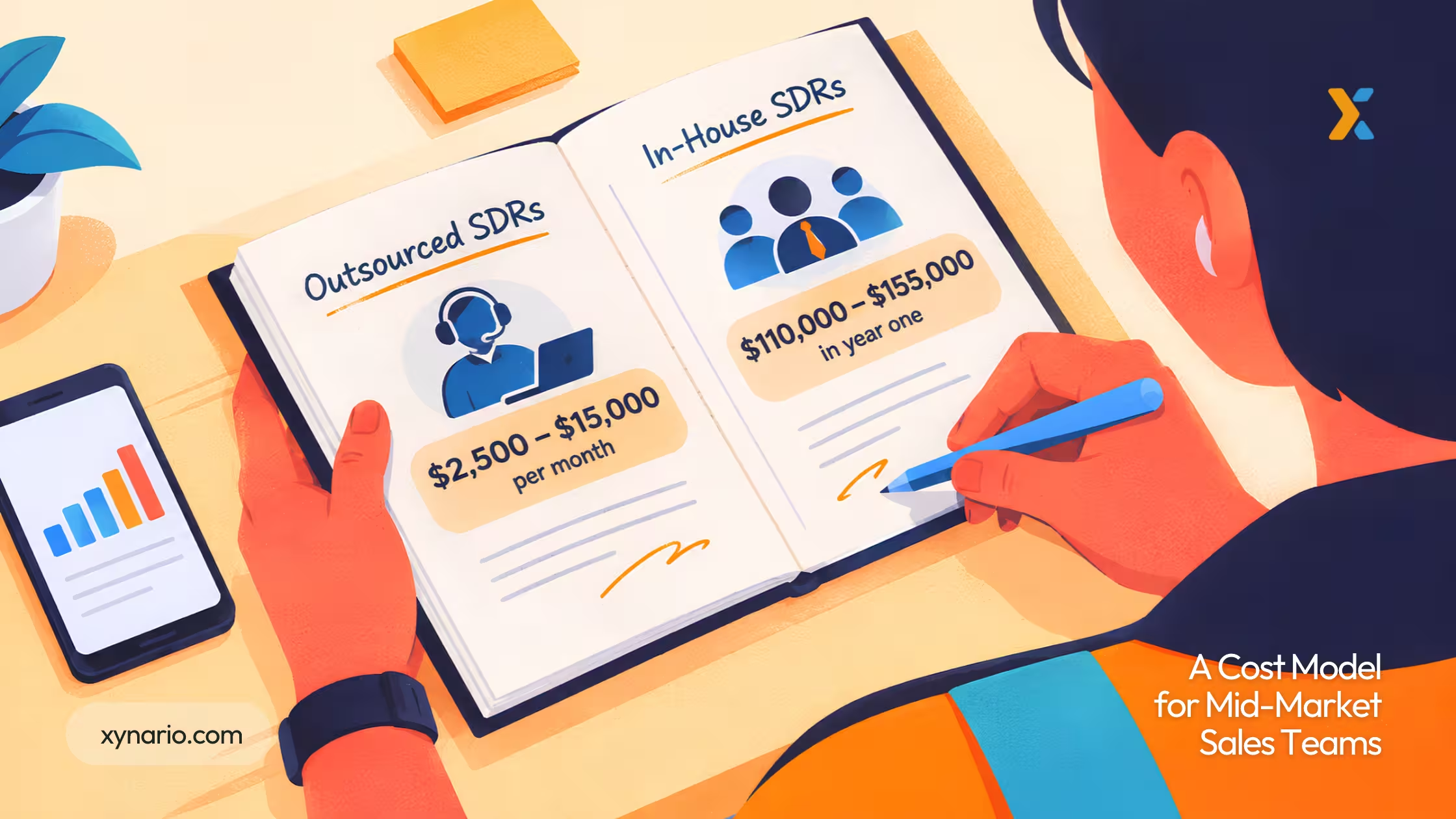
Summary: The typical outsourced SDR cost is $2,500 to $15,000 per month, compared with about $110,000 to $155,000 in year one for an in-house SDR. Judge both by cost per qualified, held meeting, which depends on your ICP, your qualification rules, and whether your outbound motion is already proven.
TL;DR: Key Takeaways
- Salary is the smaller part of an in-house seat, which costs about $142,400 in year one in this model.
- Outsourced pricing comes in three forms: retainer, pay per meeting, or a hybrid, each rewarding different vendor behavior.
- Turnover moves the three-year math: attrition rising from 20% to 60% adds about 8% per held meeting.
- Qualified share decides the winner: in the worked example, an agency ties the in-house seat at about 37%.
- Break-even math is a floor test, so add the decision matrix before you commit to either option.
- Contract terms protect you: write the held-meeting SLA, qualification rules, and pilot exit before you sign.
Outsourced SDR cost usually lands between $2,500 and $15,000 a month, which is far below the first-year price of an in-house hire but not automatically cheaper per meeting. Over three years, the answer turns on cost per qualified, held meeting, because median SDR attrition is 40% a year and every replacement restarts the ramp.
If your CFO wants you to justify a retainer against a new hire, you need numbers they can audit line by line. Here is how those numbers break down:
How much does an outsourced SDR cost compared with an in-house SDR?
In this article’s model, one in-house SDR costs $142,400 in year one, while a mid-range outsourced program costs $75,000, so outsourcing is cheaper on price alone. Price is not output, and the sections below show where the gap narrows.
The outsourced SDR vs in-house SDR choice comes down to four dimensions, shown in the table with an AI-assisted hybrid for reference.
| Dimension | In-house SDR | Outsourced SDR program | AI-assisted hybrid |
|---|---|---|---|
| Year-one cost in this model | $142,400 | $75,000 ($6,000 a month plus $3,000 setup) | $100 to $5,000+ per month for AI tooling, plus reviewer time |
| Time to first qualified meeting | 3 to 6 months | 4 to 8 weeks | Depends on domain setup, warmup, and data checks |
| Control | Full control of messaging and data | Shared: the vendor executes, you own ICP and qualification rules | High when a person approves every message |
| Main risk | Attrition and a restarted ramp | Meetings that book but do not qualify | Deliverability and low-quality volume |
According to the Glencoco 2026 State of Sales Development report, time to first qualified meeting is 3 to 6 months in-house and 4 to 8 weeks with an agency. Instantly’s AI SDR pricing analysis puts platforms at $100 to more than $5,000 a month, before domain setup, warmup, data verification, and overages.
What does a fully loaded in-house SDR cost?
A fully loaded SDR cost lands at about $142,400 in year one under this model, inside the ranges most 2026 estimates report. Published figures include $116,500 to $154,800 in Instantly’s analysis and $110,000 to $150,000 in SalesHive’s cost breakdown. Each author counts tooling and management time differently, so use the ranges as a sanity check and build your own line items.
The table lists each line item and the assumption behind it.
| Line item | Year-one cost ($) | Assumption |
|---|---|---|
| Base plus variable pay at target | $80,000 | Bridge Group median OTE |
| Employer taxes and benefits | $24,000 | 30% of OTE (assumption) |
| Tools and data | $14,400 | $1,200 per month (assumption) |
| Recruiting | $6,000 | One-time fee per hire (assumption) |
| Management time | $18,000 | 15% of a $120,000 manager (assumption) |
| Total | $142,400 | Excludes vacancy gaps, office costs, and equity |
Salary, benefits, and tooling
According to Cirrus Insight’s summary of the Bridge Group 2025 report, median SDR on-target earnings (OTE) are $80,000, split into $55,000 base and $25,000 variable.
The Bureau of Labor Statistics reported that benefits made up 31.5% of total compensation for full-time private industry workers in June 2026, which works out to about 46 cents per wage dollar. The model uses 30% of OTE, so your real figure may be higher.
A functional outbound stack runs $500 to $2,000 per month, according to Danish Lead Co. The model uses $1,200 per month for contact data, a dialer, and a sequencing seat.
Recruiting, ramp time, and management time
Cience’s digest of the Bridge Group 2025 report puts average SDR ramp time at 3.0 months, with only 60% of SDRs at quota. The model treats ramp as lost output instead of extra cost and assumes a new hire produces 50% of quota during those three months.
Recruiting adds $6,000 per hire, and management adds $18,000, which is 15% of a $120,000 manager’s loaded cost. Both figures are assumptions, so replace them with your own recruiter fees and manager salary before you show the model to finance.
How much do outsourced SDR services cost, and what do the pricing models include?
Most outsourced SDR providers price in one of three ways: a monthly retainer, a fee for each meeting, or a hybrid of both. The table summarizes published ranges, which vary widely by ICP seniority and scope.
| Pricing model | Published price range | What drives the price | Watch for |
|---|---|---|---|
| Monthly retainer | $2,500 to $15,000 per month | Scope, channels, number of reps | Paying for activity, not outcomes |
| Pay per meeting | $150 to $400 for typical programs, $1,000 to $2,000 for mid-market and enterprise ICPs | Seniority of the buyer you target | Booked meetings that never hold |
| Hybrid | Lower retainer plus a per-meeting fee or 5% to 20% commission | Split between fixed and variable fees | Stacked fees |
Prospeo’s outsourcing guide reports retainers of $2,500 to $15,000 per month, commission layers of 5% to 20% on hybrid models, and setup and training fees of $500 to $5,000 on top.
Pay-per-meeting pricing depends on who you target. Danish Lead Co reports $150 to $400 per meeting for typical programs, while SyncGTM lists $1,000 to $2,000 per appointment for mid-market and enterprise ICPs.
Pro Tip
Ask every vendor for the all-in monthly cost, then divide by held meetings, not booked meetings. A $500 booked meeting costs about $714 per held meeting at a 70% show rate.
What do offshore SDR seats cost?
One vendor-published estimate from Stealth Agents puts outsourced or offshore SDR seats at $35,000 to $65,000 a year, against $115,000 to $165,000 for an in-house seat.
A lower price shifts the risk instead of removing it. You still need a written qualified meeting definition, a way to audit message quality, and held-meeting reporting in your CRM.
How does SDR turnover change the three-year cost?
In this model, a rise in the SDR turnover rate from 20% to 60% adds about 8% to the three-year cost per held meeting. According to Cirrus Insight’s Bridge Group summary, median annual attrition is 40%, made up of 13% involuntary exits, 11% voluntary exits, and 16% promotions, with average tenure of 1.9 years.
Promotions still leave a seat to backfill, so the model charges recruiting and a restarted ramp for every exit. The table follows one seat over 36 months at three attrition rates.
| Annual attrition (%) | Replacements in three years | Three-year cost per seat ($) | Held meetings | Cost per held meeting ($) |
|---|---|---|---|---|
| 20% | 0.6 | $418,800 | 336 | $1,246 |
| 40% (Bridge Group median) | 1.2 | $422,400 | 327 | $1,292 |
| 60% | 1.8 | $426,000 | 318 | $1,340 |
Year one costs $1,356 per held meeting because the hire spends three months ramping, while the three-year figure at 40% attrition is $1,292. A one-year comparison charges the in-house SDR for the whole ramp and none of the exits, and a three-year view charges for both.
The model excludes vacancy gaps, pipeline lost in flight, and manager time spent hiring, so treat the 8% as a floor, not a forecast.
What is the cost per qualified, held meeting for each model?
Cost per qualified, held meeting equals total program cost divided by the meetings that were booked, attended, and passed your qualification test. Four meeting states matter, and vendors often report only the first:
- Booked: a calendar invite exists.
- Held: the prospect attended the meeting.
- Qualified: budget, authority, need, and timeline meet your written definition.
- Sales-accepted: an account executive accepts it as an opportunity in the CRM.
Use this formula to compare any two models: cost per qualified, held meeting = total cost ÷ (booked meetings × show rate × qualified share). It gives you the SDR cost per meeting figure that finance can audit.
The worked example uses a mid-market SaaS team that sells a $40,000 ACV product. Over three years, the in-house seat costs $422,400 for 327 held meetings ($1,292 each), and the outsourced program costs $219,000 for 324 held meetings ($676 each) at nine held meetings a month.
If 70% of the in-house SDR’s held meetings qualify, the in-house cost is $1,845 per qualified, held meeting. The table shows the outsourced cost at different qualified shares.
| Agency qualified share (%) | Outsourced cost per qualified, held meeting ($) | Compared with in-house ($1,845) |
|---|---|---|
| 70% | $966 | Outsourced is cheaper |
| 50% | $1,352 | Outsourced is cheaper |
| 37% | $1,827 | About equal |
| 30% | $2,253 | In-house is cheaper |
Key Takeaway
In this example, the agency ties the in-house seat when about 37% of its held meetings pass your qualification test. Below that share, the cheaper retainer costs more per qualified meeting.
How do you calculate the break-even point between in-house and outsourced SDRs?
To find the break-even point, divide the in-house seat’s annual cost by the outsourced price per held meeting. Follow these steps:
- Calculate steady-state seat cost after year one, which is $136,400 in this model.
- Get the all-in outsourced price per held meeting, including setup, tools, and fees.
- Divide seat cost by that price to get break-even held meetings a year, then divide by 12.
- Compare the result with realistic output, such as the Bridge Group median quota of 10 held meetings a month.
- Adjust both sides for qualified share using the formula in the previous section.
| Outsourced price per held meeting ($) | Break-even held meetings per month | Cheaper option at 10 held meetings a month |
|---|---|---|
| $500 | 22.7 | Outsourced |
| $676 | 16.8 | Outsourced |
| $1,000 | 11.4 | Outsourced, narrowly |
| $1,500 | 7.6 | In-house |
The Bridge Group’s 2025 figures show a median quota of 10 held meetings a month and only 60% of SDRs at quota, so treat 10 as the upside case when you test a hire.
This table follows the “standard analysis” that Frédéric Dalsace, William Ross, and Erin Anderson examined in a Business Horizons paper. They argue it is too simplistic and ignores coverage efficiency and selling effectiveness, which is why the next section adds judgment to the math.
When should a mid-market team outsource SDRs, and when should it hire in-house?
Outsource when speed matters more than long-term unit cost and your outbound motion is already proven, and hire in-house when volume justifies several seats and the product demands deep knowledge. Treat the seat counts in the table as rules of thumb from this model and the sources, not research findings.
| Situation | Starting point | Reason |
|---|---|---|
| Outbound is unproven and the ICP keeps changing | Founder-led or AE-led outbound, then a short paid pilot | SaaStr’s Jason Lemkin wrote that it is hard to outsource work you do not already know well |
| Proven motion, volume for fewer than three seats, speed matters | Outsourced program with a held-meeting SLA | You avoid fixed cost and a three-month ramp while you confirm volume |
| Proven motion, three or more seats, stable ICP | In-house team, with outsourced overflow if needed | Fixed cost spreads across more meetings, and you control data and messaging |
| High ACV, complex product, large buying committee | In-house or a tightly managed hybrid | Product knowledge and selling effectiveness outweigh unit cost |
| Testing a new region or segment | Outsourced pilot with clear targeting | One SaaStr commenter called it viable when enablement and oversight are in place |
If the matrix points in-house, the steps to build an outbound SDR team come before the first hire. Whichever route you choose, use the same held-meeting math to compare a sales staffing arrangement, an agency program, and a team you build yourself.
AI adds a third option: tools handle research, scoring, and message drafts, and a person approves every message before it sends. Results are mixed so far, since SaaStr titled its AI SDR survey write-up to say that 83 percent of respondents had not yet gotten AI SDRs to work, and teams that want to test the route can compare an AI SDR and human SDR hybrid on the same basis.
Why do outsourced SDR programs fail, and how do you prevent it?
Outsourced SDR programs usually fail because the vendor is paid for activity or booked meetings while you need qualified pipeline. In a May 16, 2023 post, SaaStr founder Jason Lemkin reported that only 7% of survey respondents said outsourced SDRs had worked, and 26% said they had partly worked.
The survey covered more than 1,200 people from SaaStr’s own audience and dates from 2023, so read it as a warning about setup, not a market-wide failure rate. Lemkin summed up his own experience in one line:
“what I personally haven’t seen is an outsourced SDR team replace an in-house one.”
Jason Lemkin, founder of SaaStr
The post and its comments point to four recurring causes:
- Unproven playbook: commenters said it is hard to outsource work you have not already done well yourself.
- Misaligned incentives: LeadHaste notes that each pricing model rewards a different vendor behavior, so a per-meeting fee rewards booked meetings.
- Management bandwidth: two startups Lemkin invested in managed scripts and lists closely, and neither stayed with the agencies past four to six months.
- Thin product knowledge: one commenter said buyers of complex B2B software expect product depth even at the appointment stage.
Each cause has a fix: measure held, qualified meetings, hand over a written ICP and scripts, assign one owner for weekly reviews, and pilot before you commit. The signs you hired the wrong agency usually show up in the first month’s meeting quality, and a structured process for choosing a B2B lead generation agency lowers the odds.
Warning
Savings claims for outsourcing come from parties that sell it, so test every claim against your own held-meeting and qualified-share numbers.
What contract terms protect you when you outsource SDRs?
Six terms protect you most: a held-meeting service level agreement (SLA), a written qualification definition, a paid pilot, full fee disclosure, replacement terms, and data ownership. Use this checklist as a starting draft for your own legal review:
- Held-meeting SLA: set a minimum number of held meetings per month and name the remedy for a miss, such as a fee credit or a free extension.
- Qualification definition: write the budget, authority, need, and timeline criteria, and give your AEs a set window to reject meetings that miss them.
- Paid pilot: fix the length, the budget, and the metric that decides whether the engagement continues before the pilot starts.
- Fee disclosure: list setup, tools, data, overage, and commission fees so the quoted retainer is the real price.
- Replacement terms: state what happens when a vendor SDR leaves, including handover of sequences, lists, and call notes.
- Data ownership: require every touch and meeting outcome in your CRM, such as HubSpot, Salesforce, or Zoho, and keep lists and sequences yours at exit.
These items describe what to ask for, not contract language, so have counsel review the final wording.
Who is this cost model not for?
This cost model does not fit teams that cannot define a qualified meeting, teams whose deal size cannot pay back either option, or teams building a large SDR organization. Four cases apply:
- No qualified meeting definition: without written budget, authority, need, and timeline criteria, cost per qualified meeting cannot be calculated.
- No CRM outcome tracking: if held and sales-accepted meetings are not logged, you cannot verify either model.
- Deal size too small: multiply ACV by your meeting-to-close rate, and compare the result with your cost per qualified meeting.
- Six or more SDR seats: the Bridge Group’s typical span is 6.4 SDRs per manager, so a larger team needs a team-level model, as Cirrus Insight’s summary of the report shows.
As an illustration, a $40,000 ACV and an assumed 10% close rate give $4,000 of expected first-year revenue per held meeting, above every cost in the sensitivity table. Use your own close rate, since 10% is an assumption, not a benchmark.
Final Thoughts
Neither model wins on price alone. The better comparison is cost per qualified, held meeting over three years, adjusted for attrition and for the share of meetings that pass your qualification test.
Take these steps in order to turn the model into a decision:
- Calculate your seat cost using the line items in the in-house table with your own pay, tooling, and management numbers.
- Write your qualified meeting definition and agree on it with sales and marketing before you request a quote.
- Ask each vendor for an all-in price per held meeting, then compute your break-even meetings and break-even qualified share.
- Match the result to the decision matrix, and start any outsourced engagement with a paid pilot and a written exit metric.
If your motion is proven and volume sits above the break-even line, hire in-house. If volume sits below it, or the motion is still unproven, run a pilot first.